Key Takeaways
1. Copper exports reached 3.4 million tonnes in 2025, reinforcing the country’s importance to global supply.
2. Output must rise from 890,346 tonnes in 2025 to 3 million tonnes by 2031, requiring major investment in mines and power.
3. Processing and transport constraints remain significant, even as global copper supply could fall 25% short of demand by 2035.
The DRC is exporting at record levels, Zambia is targeting a threefold production increase, and the global copper market remains finely balanced.
Copper is emerging as one of Africa’s most consequential strategic commodities. Rising demand from power grids, renewable energy, electric vehicles and data centres strengthens the investment case for copper. However, the more important African story is not simply that copper demand is growing. It is that the Democratic Republic of Congo and Zambia are becoming increasingly important to the world’s ability to meet that demand.
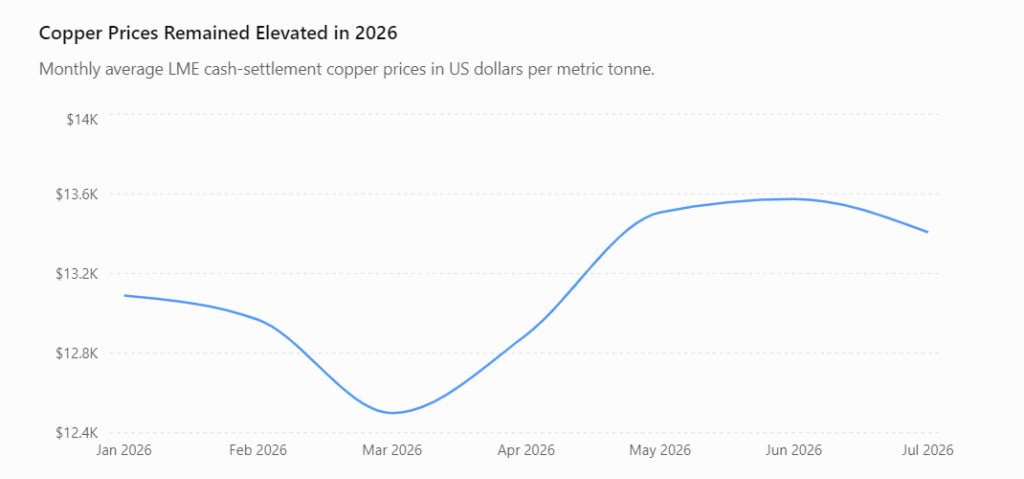
The DRC exported a record 823,887 tonnes of copper in the first quarter of 2026, up 4.8% year-on-year. This followed approximately 3.4 million tonnes of exports in 2025, compared with 3.1 million tonnes in 2024. The scale matters: the DRC exported almost as much copper in three months as Zambia produced during the whole of 2025.
Zambia produced 890,346 tonnes in 2025, missing its 1 million-tonne target by nearly 110,000 tonnes. The government is now targeting 3 million tonnes annually by 2031. Achieving this would require production to increase by approximately 237%, equivalent to compound annual growth of about 22.4% over six years.
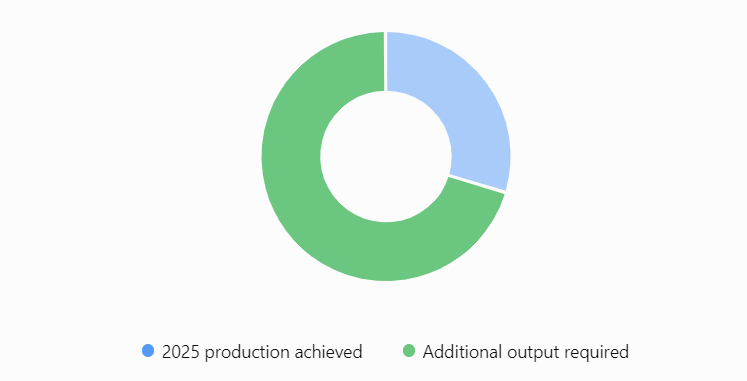
This target is ambitious relative to Zambia’s current production base. It will require large-scale investment in new mines, mine expansions, power generation and transport infrastructure. KoBold Metals’ Mingomba project illustrates the capital intensity involved: the project is expected to require between US$2.3 billion and US$2.5 billion to develop and could eventually produce 300,000 tonnes annually, although production is only targeted for the early 2030s.
The production opportunity is therefore significant, but the infrastructure constraint is equally material. In June 2026, Zambia extended the suspension of its 10% export duty on copper concentrates to allow miners to clear 271,742 tonnes of unprocessed material while major smelters underwent maintenance and repairs. The policy intervention highlights the central weakness in the regional copper value chain: mining capacity can grow faster than processing capacity.
This matters because higher mineral production does not automatically translate into maximum economic value. Exporting concentrates can support near-term volumes and foreign-exchange earnings, but smelting, refining and downstream manufacturing retain more income, employment and industrial capability within the producing country. Africa’s copper advantage will therefore depend partly on whether investment in power, rail, processing and logistics keeps pace with mine development.
Globally, copper remains finely balanced rather than immediately undersupplied. The refined copper market had a 455,000-tonne surplus in 2025. By 2026, that surplus is expected to fall to 96,000 tonnes. Relative to approximately 29 million tonnes of expected global usage, the 2026 buffer represents only around 0.3% of consumption. Global mine production is expected to grow by only 1.6%, while refined production slows to 0.4%.
The near-term surplus should therefore not be confused with long-term abundance. The International Energy Agency projects that announced mining projects could still leave copper supply approximately 25% below demand by 2035. New projects in the DRC and Zambia have narrowed the gap from 30%. This reinforces the Copperbelt’s role in global supply security.
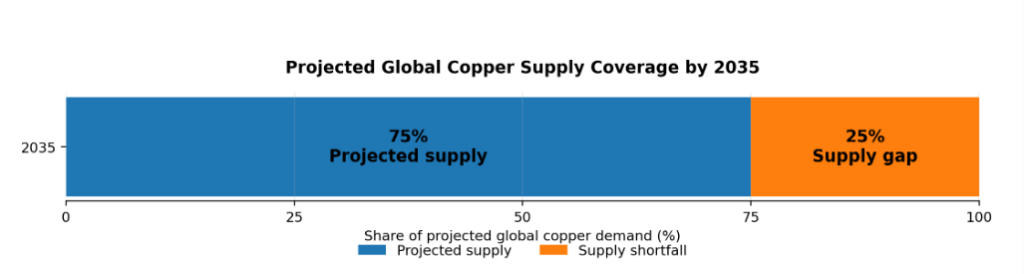
Global copper supply may cover 75% of demand by 2035.
Africa’s copper case is ultimately an execution story. The DRC has established scale, while Zambia has set an aggressive growth target. The biggest gains will come where production growth is matched by power, transport, revenue control and local processing.
The opportunity is not merely to extract more copper. It is to retain more of the value generated by every tonne.