African bond markets are showing renewed activity, but the recovery remains uneven and should not be mistaken for a full recovery in borrowing conditions. Governments are returning to both domestic and international debt markets. However, this is happening in a challenging environment, with borrowing costs still high, repayment pressures still significant, and investor confidence varying widely across countries.
Growth of the African Bond Markets
Between 2007 and 2024, Africa’s annual sovereign debt issuance rose from about $70 billion to $350 billion, while outstanding bond debt increased from around $160 billion to $730 billion. Issuance as a share of GDP also rose from 5% to 15%.
This shows that bond markets now play a much larger role in how African governments raise and manage public financing.
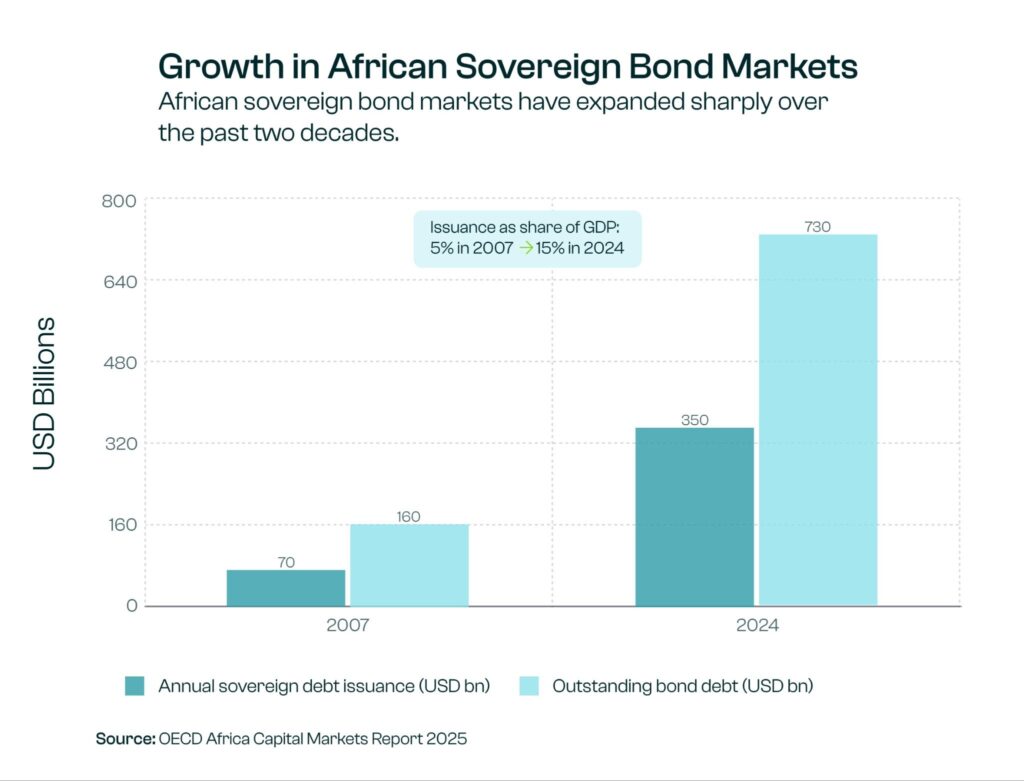
However, deeper issuance does not automatically mean healthier markets. Africa still accounts for only about 1% of global sovereign bonds despite representing around 3% of global GDP. This shows that the continent’s bond markets remain small in global terms, even though they are becoming more important domestically.
The Shift Toward Local-Currency Borrowing
The first major shift is the rise of local-currency borrowing. After access to international markets became more difficult from 2022, many African governments relied more heavily on domestic bond and Treasury bill markets to raise funding.
This trend is visible across larger markets. South Africa’s domestic government debt stood at about R5.09 trillion by March 2025, with bonds making up roughly R4.54 trillion. Egypt’s domestic budget sector debt reached about EGP 10.69 trillion by March 2025. Nigeria’s total domestic public debt stood at about ₦84.85 trillion by December 2025, while Kenya’s domestic debt reached about KSh 6.33 trillion by June 2025.
This shift reduces some foreign-currency risk because governments borrow more in their own currencies instead of dollars. But it also creates another challenge: domestic borrowing is often expensive, and in many countries, it is concentrated in shorter-term instruments such as Treasury bills.
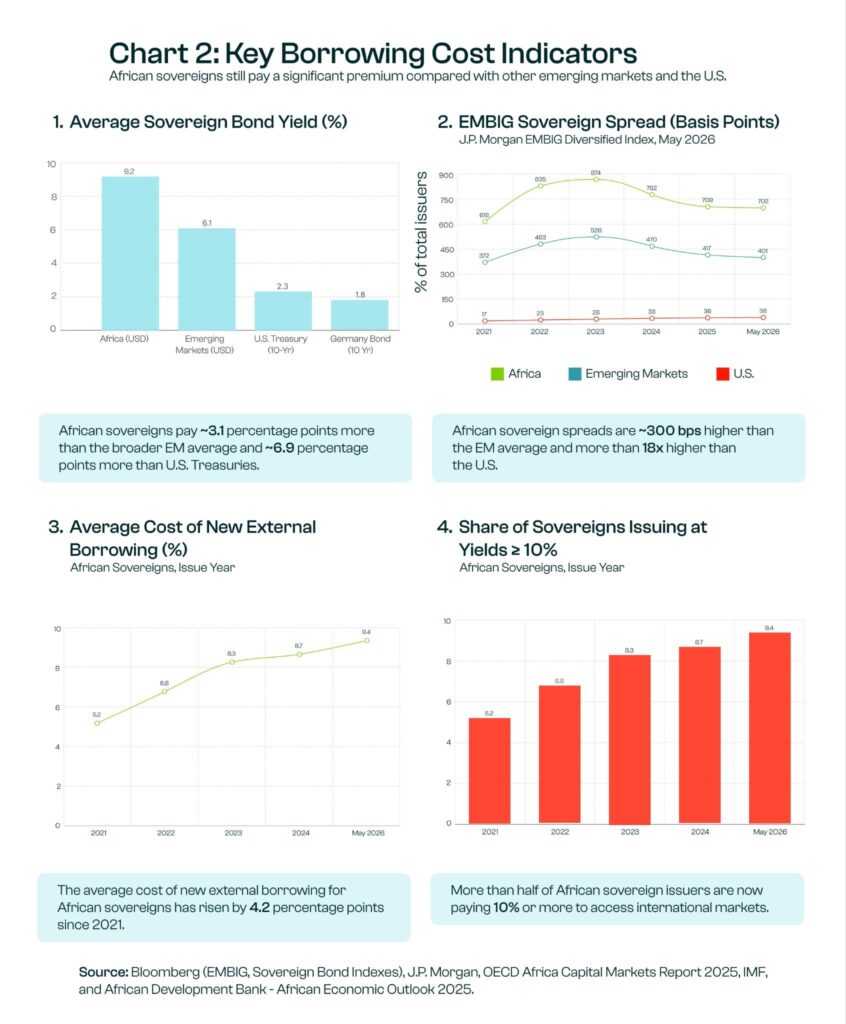
In 2024, the median sub-Saharan African country issued domestic debt at an average interest rate of 8.8%. Africa’s real yields on local-currency bonds also reached around 5%, the highest level since at least 2007. Meanwhile, USD-denominated African bond yields were close to 9% in 2024.
So the issue is not just where African governments borrow. Whether they borrow locally or externally, the cost of capital remains high.
The Eurobond Market Is Reopening
The second major shift is the return of African Eurobond issuance. After a freeze in sub-Saharan African Eurobond issuance between 2022 and January 2024, countries began returning to global markets.
By early 2026, sub-Saharan Africa had recorded its strongest-ever start to a year for Eurobond issuance, with about $6 billion in sales from countries including Benin, Kenya and Côte d’Ivoire.
Recent deals show the market reopening.
Kenya issued $2.25 billion in Eurobonds in February 2026 to fund a $500 million buyback and support its budget. Côte d’Ivoire raised $1.3 billion through a 15-year international bond. The Democratic Republic of Congo raised $1.25 billion in April 2026 through its first-ever international bond sale, with yields of 8.75% on its 2032 bond and 9.50% on its 2037 bond. On the corporate side, Morocco’s OCP raised $1.5 billion through a hybrid dollar bond, with coupons of 6.74% and 7.37%.
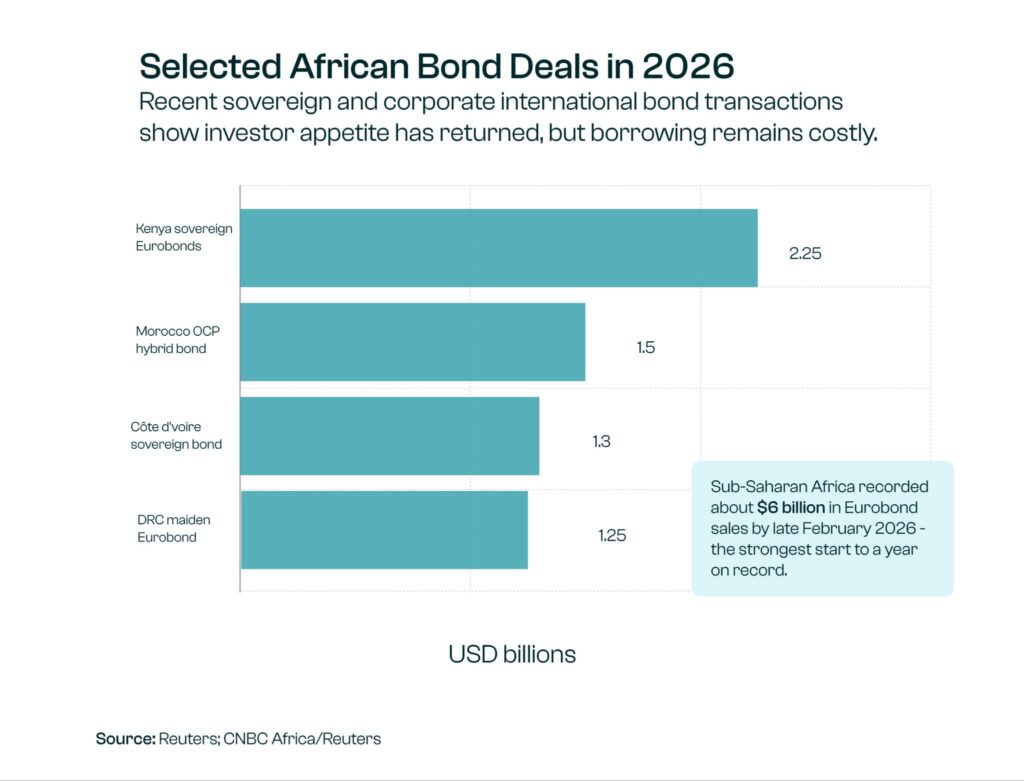
These transactions show that investor appetite has returned.
Growth Remains Supportive, But Not Enough
Africa’s growth story remains attractive. The African Development Bank projects the continent to grow by 4.1% in 2025, 4.4% in 2026 and 4.6% in 2027.
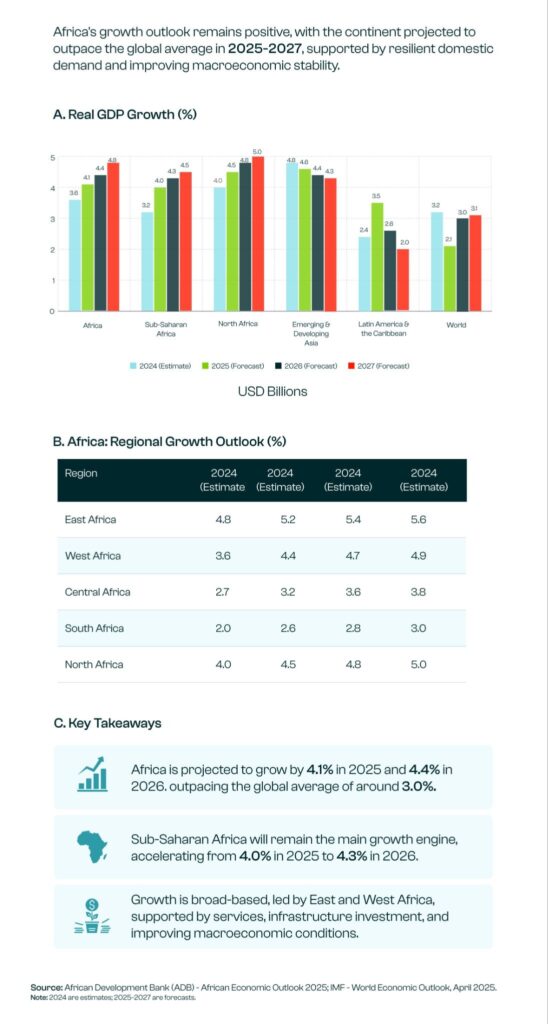
Africa’s growth outlook remains positive, with the continent projected to grow faster than the global average between 2025 and 2027. Africa’s real GDP growth is expected to rise from 3.6% in 2024 to 4.1% in 2025, 4.4% in 2026 and 4.6% in 2027, compared with global growth of around 3.0% to 3.2% over the same period. This suggests that African economies are still expanding despite global uncertainty, supported by domestic demand, services, infrastructure investment and improving macroeconomic conditions.
However, the regional picture is uneven. East Africa remains the strongest performer, reaching 5.6% by 2027, followed by North Africa at 5.0% and West Africa at 4.9%. Central Africa also improves gradually, while Southern Africa remains the weakest region, rising from only 2.0% in 2024 to 3.0% in 2027.
For bond markets, this matters because stronger growth can improve government revenue and repayment capacity, but investors will still focus on inflation, debt levels, currency stability and fiscal discipline before pricing African sovereign risk.
Debt Service Is Crowding Out Development Spending
The biggest pressure point for many African governments is no longer just the size of debt, but the cost of servicing it. A typical government in sub-Saharan Africa now spends about one-seventh of its revenue on interest payments. This means a significant share of public income is being used to pay for past borrowing before governments can fund new priorities.
Every dollar used to service debt is a dollar that cannot be fully directed toward roads, schools, hospitals, energy systems, food security, industrial policy or climate-resilient infrastructure. In countries already facing tight budgets, high debt-service costs reduce fiscal space and make it harder to invest in the foundations of long-term growth.
This is why high bond yields are not just a financial market concern. When governments borrow at elevated rates, the cost eventually flows into public budgets. Higher interest payments can delay infrastructure delivery, weaken social spending, and force governments to make difficult choices between repayment obligations and development needs.
The central issue is sustainability. Bond markets can support development when borrowing is affordable, long-term and linked to productive investment. But when debt becomes expensive and repayment-heavy, it can limit the very growth that borrowing was meant to support.
The Real State of the Market
The state of African bond markets is best described as a cautious recovery. Activity has improved, issuance windows have reopened, and investors are once again looking at African sovereign debt. However, this recovery remains fragile because access to capital is still expensive and uneven across countries.
Investors are returning, but they are demanding high yields to compensate for currency risk, fiscal pressure, refinancing needs and weaker credit ratings. This means governments can raise money again, but often at a cost that puts additional pressure on future budgets.
Domestic borrowing has also increased, as many governments rely more on local bond and Treasury bill markets. This reduces some exposure to dollar debt, but it does not remove the risk. In many countries, domestic markets remain shallow, investor bases are narrow, and borrowing is still concentrated in short-term instruments. This can create pressure on local banks, pension funds and private-sector credit.
Eurobond markets have also reopened, but access remains selective. Stronger reform-led countries are more likely to attract investor demand, while weaker sovereigns still face high yields or limited access. This shows that investors are not treating Africa as one market. They are separating countries based on policy credibility, debt transparency, reserve strength, inflation control and repayment capacity.
The main lesson is that Africa’s bond market recovery is not simply about more issuance. The quality of that issuance matters. If new borrowing is used to refinance old debt without improving growth, revenue and fiscal discipline, the recovery could remain shallow. But if governments use market access to fund productive investment, extend maturities and strengthen investor confidence, bond markets can become a more sustainable source of long-term capital.
Outlook: What Will Define the Next Phase
Over the next three years, African bond markets are likely to remain active but selective. More governments will return to Eurobond and domestic markets, mainly to refinance existing debt and manage repayment pressure. However, borrowing will remain easier for countries with stronger reforms, stable currencies, credible budgets and better debt transparency.
Domestic bond markets will become more important as governments try to reduce dollar exposure, but high local interest rates could pressure banks, pension funds and private-sector credit. The key risk is that debt service continues to crowd out development spending.
Overall, the next phase will be defined by quality, not just issuance volume. African governments will need to prove that new borrowing supports productive investment, longer maturities and stronger fiscal discipline.