Key Takeaways
- Africa’s credit challenge is not only a shortage of capital. It is a problem of trust, verification, and distribution.
- Private credit can help finance businesses that traditional banks often overlook, especially SMEs, exporters, agribusinesses, logistics companies, energy providers, real estate operators, and infrastructure-linked businesses.
- Tokenization could become the trust layer that makes private credit more transparent, traceable, and scalable across African markets.
- The opportunity is not crypto speculation. It is regulated financial infrastructure that helps capital move into productive businesses with stronger visibility, control, and investor confidence.
Africa’s next growth cycle will not be defined only by GDP growth. It will be defined by how effectively capital reaches the businesses and sectors that create jobs, expand production, and improve household incomes.
The African Development Bank projects Africa to grow by 4.2% in 2026, slightly below 4.4% in 2025. This growth is positive, but it does not automatically mean deeper economic transformation. A large share of growth across the continent remains concentrated in capital-intensive sectors such as mining, oil, gas, and extractives. These sectors can strengthen exports and government revenue, but they do not always create enough broad-based employment or support the SMEs that drive everyday economic activity.
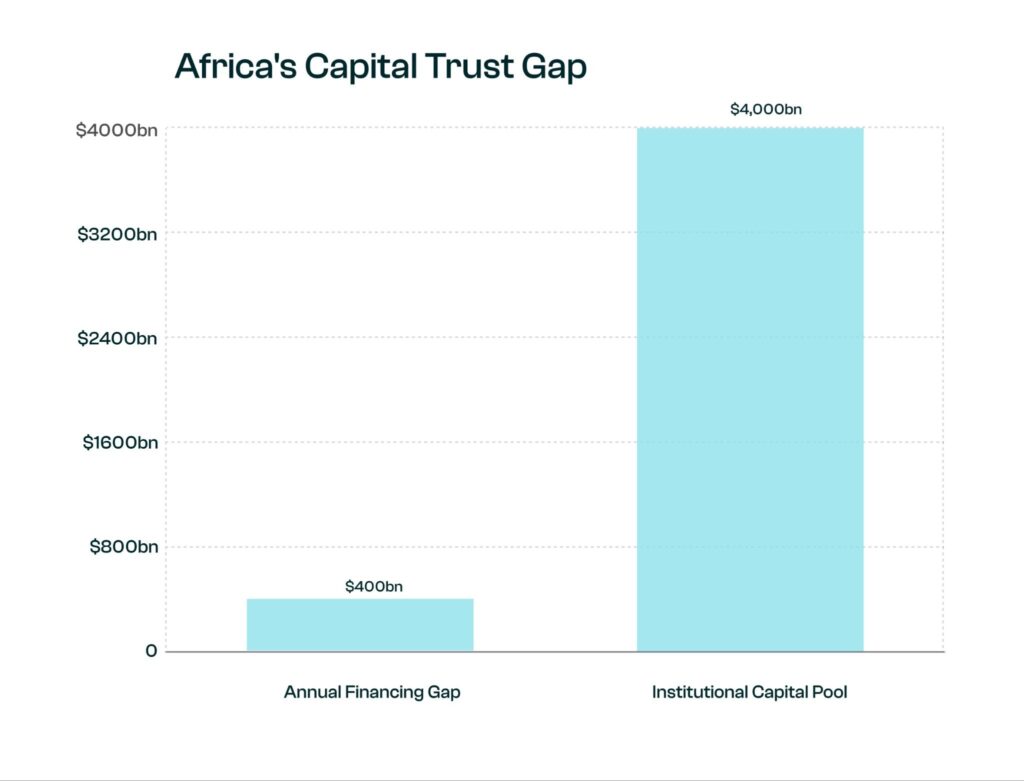
The larger issue is financing design. Africa faces an annual development financing gap of more than $400bn across infrastructure, energy, food security, industrialization, climate resilience, and job creation. At the same time, the continent holds close to $4tn in institutional capital across pensions, sovereign funds, insurers, banks, and long-term savings pools.
This creates the central contradiction
Africa has capital, but too much of it is not flowing efficiently into productive sectors.
The Digital Infrastructure Behind Private Credit
Private credit offers Africa a more flexible way to finance businesses that traditional banks often overlook. Unlike bank loans, which usually depend on hard collateral such as land, buildings, guarantees, or long operating histories, private credit can be structured around cash flows, contracts, invoices, receivables, inventory, equipment, leases, project revenues, and offtake agreements. This matters because many African businesses are commercially viable but under-collateralized. They have customers, demand, purchase orders, and receivables, yet still struggle to access formal bank finance.
With Sub-Saharan Africa facing an estimated $331 billion MSME financing gap, and the continent needing over $400 billion annually for development while holding close to $4 trillion in institutional capital, the issue is not only capital availability. It is the ability to verify, distribute, and monitor capital effectively. Tokenization can strengthen this process by turning real-world assets or financial claims, such as invoices, receivables, warehouse receipts, trade contracts, project revenues, and loan participations, into digital records that can be verified, tracked, transferred, and monitored. This creates a clearer trust layer for private credit: investors can see what backs the loan, lenders can monitor how funds are disbursed, borrowers can use verified assets to access capital faster, and regulators can identify where risks are building.
As global private credit grows from over $2 trillion today toward a projected $3.4 trillion by 2030, and tokenized financial assets are forecast to approach nearly $2 trillion by 2030, Africa has an opportunity to use tokenization not as a speculative tool, but as financial infrastructure that makes private credit more transparent, investable, and accessible.
Africa’s Financing Gap Is Also a Trust Gap
Africa’s financing gap is often discussed as a shortage of money. That is only part of the problem. The deeper issue is that capital holders often lack the trust, data, and visibility needed to lend confidently into productive sectors.
Sub-Saharan Africa has an estimated $331bn MSME financing gap. This number is important because MSMEs are not peripheral to the economy. They are the businesses that hire workers, supply goods, provide services, move products, support households, and create local productivity.
When these businesses cannot access finance, the effect is immediate. They cannot buy stock. They cannot execute contracts. They cannot hire workers. They cannot scale production. They cannot reduce prices through efficiency. That means the financing gap eventually becomes a jobs gap, an income gap, and a productivity gap.
This is where private credit and tokenization intersect.
Private credit can provide flexible capital. Tokenization can provide the trusted infrastructure that makes the capital easier to verify, deploy, monitor, and report.
Source: Mckinsey
The Scale of the Opportunity
Globally, private credit has already become a major financing channel. The asset class now manages more than $2tn and is projected by PwC to reach about $3.4tn by 2030. This reflects a structural shift in finance: borrowers want flexible funding, while investors want income-generating assets.
Tokenization is moving in the same direction. McKinsey estimates that tokenized financial assets could reach nearly $2tn by 2030 in its base case, excluding cryptocurrencies and stablecoins. In a more optimistic scenario, the figure could reach around $4tn. BCG and ADDX have estimated a much larger $16.1tn tokenized asset opportunity by 2030, equal to roughly 10% of global GDP.
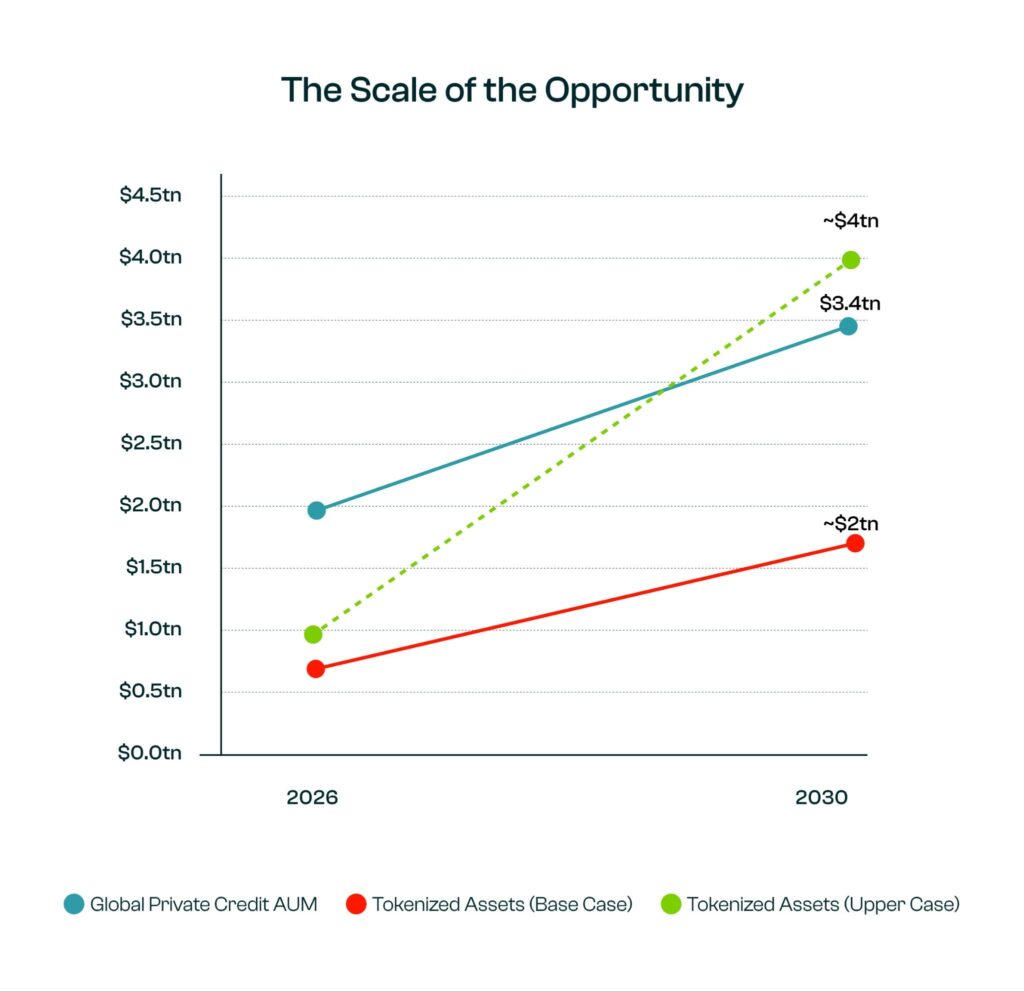
Source: PWC
The direction is clear, financial assets are becoming more digital, more programmable, and more transparent.
Africa is still early in this transition, but alternative capital is already active. In 2025, Africa recorded 530 private capital deals worth $5.1bn, with deal volume rising 8% year-on-year even as total deal value declined by 5%. This suggests investors are still active, but more selective.
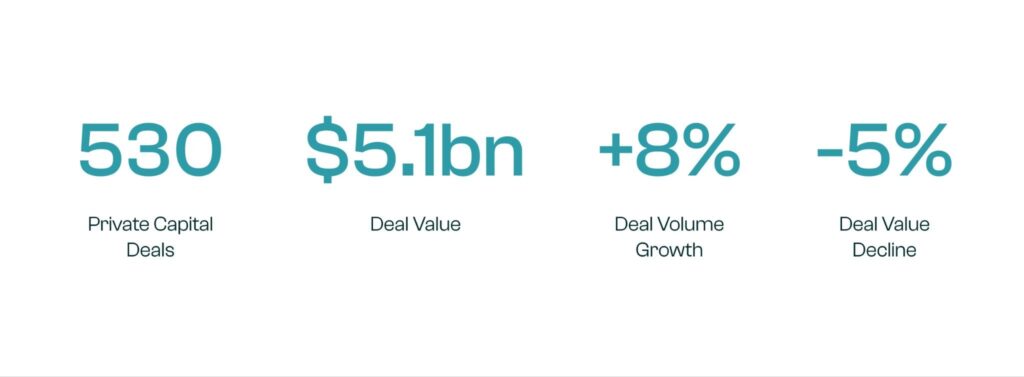
Source: AVCA, 2025, African Private Capital Activity Report
How Tokenization Could Drive Credit Access
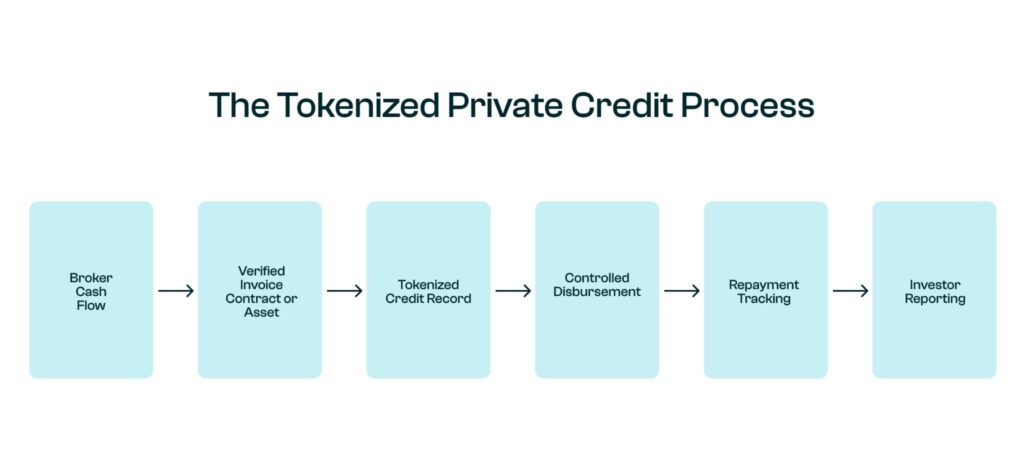
- Tokenization could drive private credit access across Africa by making the lending process more transparent, controlled, and investable. One of the biggest barriers to private credit is verification. Before lenders disburse capital, they need confidence that an invoice, receivable, contract, warehouse receipt, or asset actually exists and can support repayment. Tokenization can help by turning these real-world assets or financial claims into digital records that can be verified and tracked.
- It can also improve how credit is disbursed. Instead of releasing funds all at once, tokenized structures can allow capital to be released in stages based on agreed conditions, such as invoice validation, goods delivery, project milestones, or warehouse receipt confirmation.
- Beyond disbursement, tokenization can improve monitoring. Investors and fund managers can track the asset backing the loan, the borrower’s exposure, the repayment schedule, and the cash-flow performance behind the credit. This level of visibility is especially important in African markets where weak borrower data and limited documentation often make lending riskier than it needs to be.
- Tokenization can also widen participation in private credit. Pension funds, insurers, family offices, and asset managers may be more willing to allocate capital if they can see clearer records of the underlying credit assets and understand how repayment is being managed. Over time, tokenized credit assets could also support liquidity by making it easier for investors to buy, hold, or transfer exposure to private credit. However, this will depend heavily on regulation, legal clarity, investor protection, and market depth.
The Risks
Tokenized private credit can improve transparency, but it does not remove the basic risks of lending. A weak borrower remains weak, a fake invoice remains fake, and a poorly structured loan remains risky, even when represented digitally. The quality of the borrower, the strength of the cash flow, and the credibility of the underlying asset still matter.
The main risks sit around underwriting, asset verification, and currency exposure. If lenders chase yield without properly assessing repayment capacity, defaults can rise. If invoices, receivables, contracts, or warehouse receipts are not properly verified, tokenization can create a false sense of security. If borrowers earn in local currency but borrow in dollars, depreciation can quickly make repayment more difficult.
Legal and technology risks must also be managed carefully. Investors need clear rules on ownership, repayment rights, disclosure, and enforcement. Platforms must be secure, auditable, and well-governed to avoid cybersecurity, data, or operational failures. The key point is that tokenization should strengthen private credit, not disguise its risks. Its role is to make lending more transparent, traceable, and investable, while strong underwriting, legal discipline, and regulation remain the foundation.
Future Projection
Over the next five years, Africa’s private credit market is likely to become more structured, more technology-enabled, and more institutionally backed. Early signs are already visible, with African private debt deal volume rising 23% year-on-year in Q2 2025, while the market recorded 41 private debt deals by Q3 2025, nearly matching the full-year 2024 level. The global backdrop also supports this shift. Private credit is projected to grow from about $1.96tn in 2026 to $3.48tn by 2031, implying annual growth of about 12%.
The next phase will depend on reducing risk for investors. AfDB’s $125mn investment into ATIDI aims to expand guarantee coverage from about $3bn to $10bn, making African private credit easier and safer for investors to support.
Source: AVCA, 2025, African Private Capital Activity Report
The opportunity will be strongest in sectors with visible cash flows, such as trade finance, agriculture, logistics, renewable energy, healthcare, education, and income-backed real estate. These sectors produce invoices, receivables, contracts, customer payments, and project revenues that can support structured lending.
By 2031, the strongest private credit markets in Africa will likely be those that combine local institutional capital, guarantee-backed lending, cash-flow-based underwriting, and tokenized credit records.